
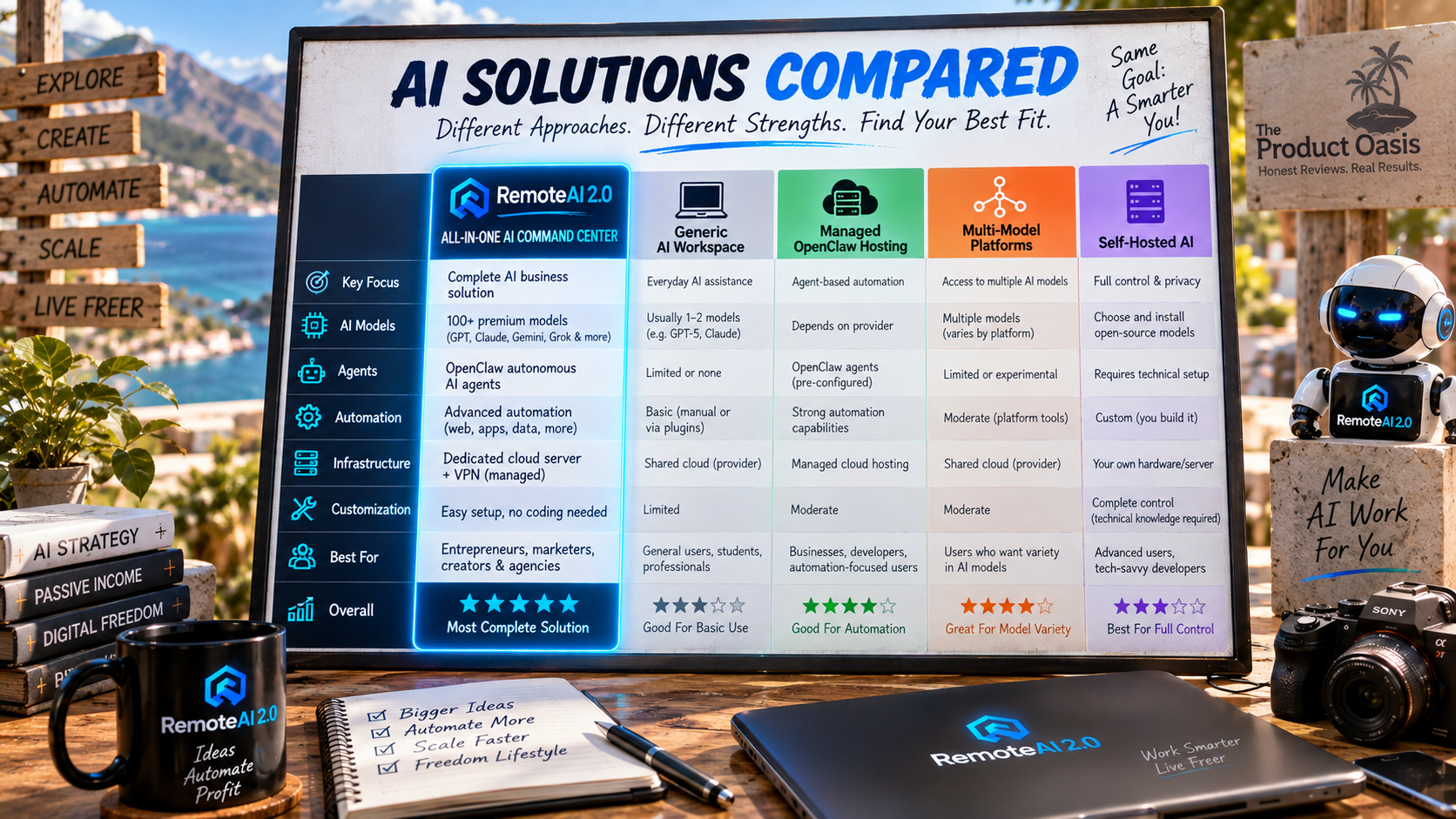
If you’re looking for the best RemoteAI 2.0 alternatives for AI agents and multi-model workflows, the right choice depends on what you actually want to replace: the OpenClaw automation layer, access to multiple AI models, the hosted server infrastructure, or the all-in-one business workflow. RemoteAI 2.0 combines several of these elements into one offer, but there are specialized alternatives that can be better suited to developers, automation builders, teams, or users who want maximum control.
What Are the Best RemoteAI 2.0 Alternatives?
The strongest alternatives are not all direct clones of RemoteAI 2.0. Some focus on autonomous agents, some on multi-model access, and others on visual workflow automation.
| Alternative | Best For | What Makes It Different |
|---|---|---|
| OpenClaw | Users who want the underlying agent infrastructure | Self-hosted gateway with multi-agent routing, tools, memory and channel integrations |
| Dify | Visual AI agents and production workflows | Visual workflow builder, agents, knowledge, tools, APIs and self-hosting options |
| OpenRouter | Multi-model access and model routing | Unified API for hundreds of models with routing and fallback controls |
| n8n | Business automation with AI agents | Connects AI agents with workflows, APIs, SaaS tools and approval processes |
| ChatGPT | General-purpose AI and research | Polished assistant experience with research, tools and agentic capabilities |
| Claude | Coding, writing and professional AI work | Strong Claude-focused ecosystem with agentic coding and productivity features |
| Gemini | Google-centric AI workflows | Deep integration with Google’s search, productivity and multimodal ecosystem |
The important point is that no single alternative necessarily reproduces every component of the RemoteAI 2.0 package. RemoteAI’s supplied product material positions it as a cloud-based OpenClaw-powered platform with a private “Ghost Server,” a dedicated VPN, persistent memory and access to 100+ AI models. :contentReference[oaicite:0]{index=0}
1. OpenClaw — Best Alternative for Maximum Control
If the main reason you’re considering RemoteAI 2.0 is OpenClaw, going directly to OpenClaw is the most obvious alternative.
OpenClaw is a self-hosted gateway for AI agents. It can run on your own computer or server and connects AI agents to messaging channels, tools, sessions, memory and other capabilities. Its architecture also supports multiple isolated agents within one Gateway, each with its own workspace, state and session history. :contentReference[oaicite:1]{index=1}
This is important because RemoteAI’s core pitch is built around OpenClaw. The supplied product material describes RemoteAI as a hosted environment where a dedicated “Ghost Server” runs OpenClaw so users don’t have to install and manage the infrastructure themselves. :contentReference[oaicite:2]{index=2}
Why Choose OpenClaw Instead?
- You want direct control over your server and configuration.
- You are comfortable managing technical infrastructure.
- You want to choose your own AI model providers.
- You want to build custom multi-agent environments.
- You don’t need RemoteAI’s bundled commercial or marketing features.
The trade-off is that self-hosting means you take responsibility for installation, security, provider credentials, updates, backups and server management. OpenClaw’s own documentation recommends secure remote-access patterns such as Tailscale or SSH rather than simply exposing the Gateway publicly. :contentReference[oaicite:3]{index=3}
Best for: developers, technical users and businesses that want control over the underlying agent infrastructure.
2. Dify — Best Visual Alternative for AI Agents and Workflows
Dify is one of the strongest alternatives if your goal is to build AI applications and workflows visually rather than manage an agent server manually.
Dify’s current Workflow Studio lets users combine model calls, knowledge retrieval, tools, code, branching, triggers and human review on a visual canvas. Workflows can run as applications, APIs or MCP-compatible tools, while Dify also supports cloud and self-hosted deployment options. :contentReference[oaicite:4]{index=4}
Dify has also expanded its agent functionality. Its current Agent system allows agents to be configured with models, prompts, skills, files and tools, and those agents can be reused across workflows. Dify describes the platform as model-agnostic, allowing commercial or self-hosted models rather than locking users into one model provider. :contentReference[oaicite:5]{index=5}
Why Choose Dify?
- You prefer drag-and-drop workflow construction.
- You want visible logic instead of relying entirely on autonomous agent decisions.
- You need knowledge bases and retrieval alongside AI models.
- You want human approval steps inside workflows.
- You want to publish AI applications through APIs or web interfaces.
- You want the option of self-hosting.
Dify is therefore particularly attractive for teams building repeatable AI applications rather than simply looking for a personal AI assistant.
Best for: businesses, developers and teams building production-oriented AI applications and agentic workflows.
3. OpenRouter — Best for Multi-Model Access and Routing
If your biggest reason for considering RemoteAI is access to lots of different AI models, OpenRouter deserves serious consideration.
OpenRouter provides a unified API for hundreds of AI models. It can automatically handle provider fallbacks and allows developers to control how requests are routed based on factors such as price, throughput, latency and provider availability. :contentReference[oaicite:6]{index=6}
It also supports model fallbacks, meaning an application can specify multiple models and automatically try another model if the primary option fails. :contentReference[oaicite:7]{index=7}
This creates a very different proposition from RemoteAI. OpenRouter is primarily an AI model access and routing layer. It isn’t marketed as an all-in-one hosted “AI business in a box” with the same collection of infrastructure and commercial features described in the RemoteAI materials.
Why Choose OpenRouter?
- You are a developer building your own AI application.
- You want access to many model families through one API.
- You want explicit control over model selection.
- You want automatic model or provider fallbacks.
- You want to optimize for price, throughput or latency.
- You want to build your own agent system on top of the model layer.
OpenRouter can also be combined with agent frameworks, making it especially interesting for developers who want to assemble their own stack rather than buy a preconfigured environment.
Best for: developers who care more about flexible multi-model infrastructure than a ready-made end-user platform.
4. n8n — Best for AI-Powered Business Automation
n8n takes a different approach again. Rather than focusing primarily on being an AI assistant, it provides a workflow automation environment where AI agents can interact with tools, APIs and business applications.
Its AI Agent node allows an agent to connect to a chat model and one or more tools, then decide which tools to use to accomplish a task. n8n also allows agents to use integrations such as Slack, Google Sheets, workflows and external MCP servers, with approval controls available for sensitive tool calls. :contentReference[oaicite:8]{index=8}
That makes n8n particularly interesting when the workflow looks something like:
- Receive a customer request.
- Classify the request with an AI model.
- Search a database or knowledge source.
- Call an external application.
- Generate a response.
- Ask for human approval when necessary.
- Send the final response automatically.
In other words, n8n is excellent when AI needs to become part of a larger business process.
Best for: marketers, operations teams, developers and businesses automating real-world processes across multiple applications.
5. ChatGPT — Best for a Polished General-Purpose AI Experience
ChatGPT is not a one-for-one replacement for RemoteAI’s infrastructure model, but it can be the better choice if you don’t actually need a dedicated agent server or multi-model environment.
ChatGPT’s Deep Research can perform multi-step research across the web and uploaded files and return structured reports with citations. Current versions also include increasingly capable agentic and workflow-oriented features depending on the user’s plan. :contentReference[oaicite:9]{index=9}
Choose ChatGPT when your priority is simplicity, research, writing, general productivity and access to OpenAI’s own ecosystem.
Choose RemoteAI instead when the specific attraction is the combination of OpenClaw automation, a hosted server environment and access to multiple AI model families.
6. Claude — Best for Claude-Centered Coding and Professional Work
Claude is another strong alternative if you don’t need a multi-model platform and primarily want a powerful AI assistant centered around Anthropic’s ecosystem.
For many users, the advantage of Claude is simplicity: you can focus on the model and its tools rather than building or maintaining an orchestration layer.
The downside, from a multi-model perspective, is obvious: if your workflow specifically requires comparing different model families, Claude alone does not provide the same multi-provider architecture as a dedicated model router or multi-model platform.
Best for: users who primarily want a high-quality AI assistant for writing, reasoning, coding and professional knowledge work.
7. Gemini — Best for Google-Centric AI Workflows
Gemini is particularly compelling when your existing workflow already revolves around Google services.
Google’s Gemini ecosystem includes research, document creation, connected services and increasingly agentic capabilities. Gemini Deep Research can combine web research with eligible connected information sources, while Google’s broader Gemini ecosystem continues to expand its ability to handle multi-step tasks. :contentReference[oaicite:10]{index=10}
Like ChatGPT and Claude, Gemini isn’t designed to be a neutral multi-model orchestration layer. Its strength is the integration of Google’s own models, products and services.
Best for: users who already live inside Google Search, Workspace and the wider Google ecosystem.
RemoteAI 2.0 Alternatives Compared
| Platform | AI Agents | Multi-Model Focus | Workflow Automation | Self-Hosting | Technical Skill |
|---|---|---|---|---|---|
| RemoteAI 2.0 | Strong vendor positioning | Strong | Strong | Hosted infrastructure | Low to moderate |
| OpenClaw | Strong | Provider-dependent | Strong | Yes | Moderate to high |
| Dify | Strong | Strong | Strong | Yes | Moderate |
| OpenRouter | Agent SDK available | Excellent | Developer-built | Not the primary model | Moderate to high |
| n8n | Strong | Provider-dependent | Excellent | Yes | Moderate |
| ChatGPT | Strong | Primarily OpenAI ecosystem | Strong | No | Low |
| Claude | Strong | Primarily Anthropic ecosystem | Strong | No | Low to moderate |
| Gemini | Strong | Primarily Google ecosystem | Strong | No | Low |
Which RemoteAI 2.0 Alternative Is Best for You?
Choose OpenClaw If You Want the Closest Technical Alternative
If you understand servers, API credentials and AI infrastructure, OpenClaw gives you access to the underlying agent architecture without requiring the RemoteAI wrapper. OpenClaw supports multiple agents, channels, sessions and workspaces, giving technical users considerable control. :contentReference[oaicite:11]{index=11}
Choose Dify If You Want Visual AI Workflows
Dify is probably the better fit if your priority is designing repeatable AI applications visually, connecting models to tools and knowledge, and keeping workflow logic visible and testable.
Choose OpenRouter If You Mainly Want Many Models
If you don’t need a hosted agent environment and simply want a convenient way to access many different models, OpenRouter is a compelling alternative. Its routing and fallback capabilities are particularly useful for developers building their own applications. :contentReference[oaicite:12]{index=12}
Choose n8n If Automation Is the Priority
If your goal is to connect AI to CRM systems, email, spreadsheets, databases, APIs and business applications, n8n can be more appropriate than a general AI platform.
Choose ChatGPT, Claude or Gemini If You Want Simplicity
If you don’t need to manage complex agent infrastructure, a mainstream AI assistant may be the most practical choice. You get a polished interface and an established ecosystem without assembling multiple infrastructure components yourself.
Is RemoteAI 2.0 Better Than Its Alternatives?
There isn’t one universal winner.
RemoteAI’s main advantage is consolidation. Its supplied product information combines OpenClaw, a private cloud “Ghost Server,” persistent memory, a dedicated VPN and access to a large collection of AI models into one package. :contentReference[oaicite:13]{index=13}
The advantage of the alternatives is specialization and control.
- OpenClaw gives you more direct control over the underlying agent infrastructure.
- Dify gives you a visual environment for building and managing agentic workflows.
- OpenRouter gives developers flexible access to hundreds of models and routing options.
- n8n gives businesses a powerful automation layer around AI and external applications.
- ChatGPT, Claude and Gemini provide polished, provider-specific AI ecosystems.
That means the best alternative depends on whether you value convenience, control, model choice, workflow design or simplicity.
Before comparing the alternatives against the full RemoteAI offer, it is also worth understanding what its optional upgrades add to the base product. See the RemoteAI 2.0 OTO breakdown here.
What to Check Before Choosing an AI Agent Platform
Don’t choose solely based on the number of models advertised. A better evaluation looks at the complete workflow.
- Model access: Which models do you actually need, and how are they accessed?
- Agent capabilities: Can the system use tools, maintain state and perform multi-step tasks?
- Automation: Can workflows run without you manually triggering every step?
- Integrations: Can it connect to the applications and services you already use?
- Privacy: Where are prompts, credentials and generated data processed and stored?
- Control: Can you configure the models, agents, tools and permissions yourself?
- Cost: Consider subscriptions, API usage, hosting, model fees and optional upgrades—not just the advertised entry price.
- Reliability: Look for logging, monitoring, error handling, fallbacks and human approval controls.
Final Verdict: The Best RemoteAI 2.0 Alternative
If you want the closest underlying technology, start with OpenClaw. If you want visual agentic workflows, Dify is one of the strongest options. If you mainly want multi-model access and routing, OpenRouter stands out. If your priority is business automation, n8n deserves serious consideration.
For users who simply want an easy-to-use AI assistant, ChatGPT, Claude or Gemini may actually be the better choice because they remove much of the infrastructure and configuration work.
RemoteAI 2.0 makes the most sense when you specifically value the combination of OpenClaw automation, hosted infrastructure, persistent memory and multi-model access in one packaged environment. The vendor claims its system is designed to handle long-running tasks and automatically select models for different jobs, but those capabilities should be evaluated against your actual requirements rather than assumed from the marketing claims. :contentReference[oaicite:14]{index=14}
Ultimately, the best platform isn’t the one with the longest feature list. It’s the one that gives you the right models, tools, automation and level of control for the workflows you actually need.
Compare the RemoteAI 2.0 OTOs and see what additional capabilities are available.